
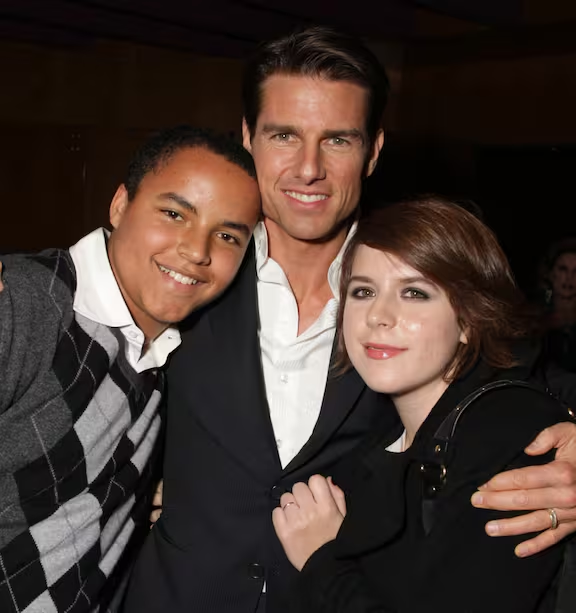


Tom Cruise children news is less about day-to-day family updates and more about how one of the world’s most controlled personal brands manages its most sensitive asset: his kids. Whenever his children appear in public or are referenced in a story, you can almost see the machinery of reputation management and privacy strategy moving in the background. For studios, tabloids, and fans, his family life is a permanent curiosity; for Cruise, it is clearly treated as risk exposure to be minimized, not content to be monetized.
Tom Cruise has three children who sit at very different intersections of fame and privacy. Two were adopted during his former marriage to Nicole Kidman, and one is a biological daughter from a later relationship. What stands out is how carefully the visibility of each child has been calibrated over time, depending on age, public interest, and media pressure. That is the strategic layer often missing when people consume Tom Cruise children news as if it were just casual gossip.
How Media Narratives Signal Shifting Boundaries Around His Children
When you track Tom Cruise children news over time, the first signal is how dramatically the volume and tone of coverage change as the children grow older. Early on, every photograph of a stroller, a school run, or a family vacation was treated as front-page material. Later, the visibility curve bent downward as each child moved into more private adult lives or, at minimum, less photographed routines.
From a business perspective, this is a classic attention-cycle pattern. The first phase is curiosity and novelty, where even mundane images generate engagement. The second phase is normalization, when media outlets realize that the marginal click-through rate tapers off. At that point, only “event-level” coverage—rare sightings, unusual public appearances, or legal developments—makes it into Tom Cruise children news.
The reality is that outlets now optimize coverage of his children the same way an e‑commerce team optimizes a product page: they test headlines, evaluate engagement, and quietly drop what no longer converts. That, more than some grand shift in ethics, explains why his kids are less visible in the mainstream newsfeed.
The Reality Of Privacy, Religion, And Public Curiosity In His Family
With Tom Cruise, you cannot separate family narrative from questions about belief, identity, and control. That is part of why Tom Cruise children news has been so persistent: people project broader debates about faith, power, and Hollywood into the smallest detail of how he parents. Public curiosity isn’t neutral; it is shaped by pre-existing narratives about who Cruise is supposed to be.
From a practical standpoint, the family’s approach looks like a layered privacy strategy. There is tight control around regular routines, schooling, and day-to-day relationships, combined with a tolerance for a few carefully contained public moments. It is the same pattern you see in well-managed consumer brands: a small amount of controlled transparency to reduce speculation, but not enough to create new angles for attack.
What I’ve learned is that once the public links children to a bigger ideological story, the stakes change. Every appearance starts to be read as proof for one camp or another. That is why the family’s silence on many specific questions is not accidental; it is a conscious refusal to feed a narrative machine that rarely plays fair.
Context, Risk, And Why Confirmation Is So Rarely Offered
When you look closely at Tom Cruise children news, you will notice how many sentences hinge on vague language: “reportedly,” “are believed to,” “have been seen,” “sources say.” That linguistic fog is not lazy writing; it reflects the fact that there is very little on-the-record, verifiable information about what happens inside his family life. The public record is narrow, and speculation fills the gaps.
From a risk-management lens, this is almost textbook. When you cannot fully control a topic, you reduce the surface area: fewer interviews, no off-the-cuff quotes, and no reactive statements to every rumor. The 80/20 rule applies here but inverted: maybe 80% of rumors are left unanswered so that energy can be reserved for the 20% that create real legal or reputational exposure.
Look, the bottom line is that confirmed detail is expensive in this context. The moment something is confirmed, it becomes a permanent reference point that can be re-used, re-framed, and re-weaponized for years. Staying non-committal is not evasive for the sake of it; it is a defensive strategy against a market that profits from over-interpretation.
Timing, Public Appearances, And The Children’s Own Emerging Agency
Over time, Tom Cruise children news has increasingly intersected with the children’s own choices rather than their father’s blockbuster schedule. As they become adults, their movements, careers, and friendships start to form their own micro-narratives. The question quietly shifts from “What is Cruise doing with his kids?” to “How do his kids choose to live with that legacy?”
From a strategic standpoint, this creates a timing challenge. Every public appearance can be read as either alignment with or distance from their father’s public identity. That is why, when one of his children appears at a high-visibility event or is absent from a milestone moment, observers are quick to interpret it as a signal—whether or not that reading is justified.
What I’ve seen in similar high-profile families is that you eventually hit a tipping point where the children’s agency matters more than the parent’s brand script. At that moment, the smartest thing the parent can do is step back publicly, even if that invites short-term speculation. Control beyond that point is more illusion than asset.
Narrative Cycles, Long-Term Reputation, And What Actually Endures
If you zoom out, Tom Cruise children news is a small but revealing case study in how long-term celebrity brands survive multiple media cycles. Early coverage was noisy and relentless; later coverage is sporadic but more loaded with meaning. In both phases, the through-line is a consistent refusal to turn the children into content.
From a practical standpoint, that has real reputational value. Brands—whether personal or corporate—that protect their most vulnerable stakeholders tend to weather crises better. The data tells us that when audiences perceive someone as guarding their family rather than exploiting them, trust erosion is slower, even when other controversies flare up.
The reality is that in ten or twenty news cycles, most casual consumers will not remember the details of any one Tom Cruise children news story. What will stick is a general sense of whether he behaved like a guardian or a showman. In that sense, the quiet strategy around his children may be one of the most important long-term decisions attached to his name.